Jan 31, 2014 | Uncategorized, Workers' Compensation
SC Workers Compensation Law 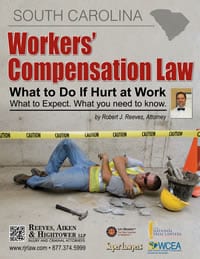
In most personal injury cases, “pain and suffering” is the most valuable part of any recovery second only to medical treatment. Workers compensation cases, while personal injury, are different. The laws were set up to make certain injured workers are compensated, but fairly harsh restrictions are placed on what benefits are available? So how were workers compensation laws created?
Before workers compensation, employees hurt at work were left with the traditional personal injury negligence theories of liability. They had to prove that their employer was negligent and that they were injured as a result. In many cases, the employer did nothing wrong, and the accident and resulting injury was actually the fault of the injured worker. Consequently, there were many serious injury cases where no compensation would be available under the law. So the laws were changed by legislatures across the country to solve this problem. The system, while not perfect, was much better at protecting injured employees. The law, as developed, provides for certain elements of damages, including medical care (but the employer gets to choose where and which doctors), lost time benefits (paid at 2/3 a workers’ average weekly wage), and payment for any resulting permanent disability (based on a percentage of impairment to the specific body part affected). In truly serious cases, an injured worker can receive lifetime medical treatment and weekly benefits. The one item left out was “pain and suffering.” Why? Because this is the element that is purely subjective in nature and cannot be easily quantified, even by juries in regular civil cases. In serious accidents, “pain and suffering” is often described as excruciating and unbearable. How can you place a dollar value on such element. As a result, the legislatures took away fault from the employer and “pain and suffering” from the employee. As we said earlier, it is not a perfect system, but injured workers are assured that if hurt on the job, they will receive medical treatment and sufficient compensation to get them back on their feet and return to work.
SC workers compensation laws are complex and can be very confusing if your lawyer is new to this area of practice. Better make sure your lawyer is experienced in this complicated field and is willing to fight for you and your family. SC workers compensation attorney Robert J. Reeves has over 25 years of workers compensation experience. He is a former Registered Nurse (RN) and former workers compensation insurance defense lawyer. He would be honored to sit down with you and review your particular case. Each case is unique, and small facts can often make a big difference in outcome. Call today for a private, confidential consultation.
Feb 15, 2013 | Uncategorized, Workers' Compensation
In the opinion for a recent workers’ compensation appeal, Brown v. Peoplease, the South Carolina Court of Appeals gives us an opportunity to review both the lax standard of review that workers’ compensation cases receive upon review to the courts and the informal nature of appeals from the initial single commissioner Workers’ Compensation Commission to the Appellate Panel (of the Workers’ Compensation Commission).
Brown v. Peoplease involved a relatively common incident: a car accident on the job. Peoplease had arranged for Brown to drive a truck for the Bulldog trucking company when Brown’s truck was hit by a passenger car (Note that since this is a workers’ compensation case, Brown’s negligence, if any, is not at issue, as it would be in an ordinary car accident case).
Peoplease’s attorneys did not contest that the injuries suffered in the accident were compensable injuries under the workers’ compensation statute. The issues at the hearing were what Brown’s compensation rate should be and the extent if any of Brown’s permanent disabilities.
Compenstion rate
Compensation rates are usually determined by dividing the total wages paid over the last four quarters by the lesser of 52 or the actual number of weeks worked, except when this method would be unfair. S.C. Code Ann. §42-1-40. Since Brown had only been working for Peoplease for 16 weeks when the accident occurred, this method was inappropriate, and Brown and Peoplease presented evidence and testimony to establish the compensation rate. The testimony of Peoplease’s corporate lawyer, who relied on her review of similar Peoplease employee’s pay rates ($26,000 to $38,500), and Brown, who offered his recollection of what he was offered at the outset of his employment conflicted ($0.50 per mile). Peoplease offered no documentary evidence, and Brown offered only his paystubs, which were of limited use because his pay rate on the stubs was “$1/hour,” far outside of the range that either party was arguing. Given this evidence, the single commissioner, as fact-finder, set the compensation rate at the highest figure cited by Peoplease, below the $0.50 per mile, Brown said he was offered.
Causation of Specific Back Injuries
Employers in workers’ compensation are only liable for injuries caused by accident on the job. Throughout Brown’s case and in doctor’s letters and notes, references were made to his back and neck injuries generally. The only evidence specifying a particular portion of the back was evidence of what surgeries were done, which were on the cervical spine (except for vague reference of lumbar pain at the initial emergency room visit). Brown also claimed injury to his lumbar spine. The single commissioner cited that back injuries are complicated and that medical testimony must be offered to support specific back injuries and disabilities, and thus, he found that, since Brown offered no medical testimony establishing the cause of his lumbar issues was the accident, he was not entitled to lifetime medical expenses for his lumbar issues. Had the doctor been specifically asked separately about the cervical spine and the lumbar spine, the doctor might have said that the lumbar problems were caused by the accident. Since he wasn’t, the single commissioner denied claims based on Brown’s lumbar problems.
Standard of Review in Workers’ Compensation Appeals
As in all South Carolina workers’ compensation appeals to the South Carolina Court of Appeals, the standard of review is that the decision of the Appellate Panel of the Workers’ Compensation Commission will not be reversed unless there is an error of law or the decision is not supported by substantial evidence. S.C. Code Ann. § 1-23-380(5)(e). Substantial evidence means evidence that would allow a reasonable person to reach the same conclusion. Lark v. Bi-Lo, Inc., 276 S.C. 130, 135, 276 S.E.2d 304, 306. Since the evidence does not completely fly in the face of a finding that there was no causation evidence as to lumbar back injuries or the compensation rate determined by the commissioner, the Court of Appeals cannot reverse.
Appellate Panel’s Adoption of Proposed Order Drafted by Respondent Attorneys
Interestingly, Brown claims that the Appellate Panel erred in having the Respondents’ attorneys prepare a proposed order affirming the single commissioner’s decision, subject to specific instructions on what to write and the commissioners’ right to modify anything in it. The Court of Appeals found no issue with this practice and supported the propriety of the Appellate Panel’s decision by citing an opinion where no issue was found with an Appellate Panel adopting a single commissioner’s findings verbatim, Trotter v. Trane Coil Facility, 393 S.C. 637, 644, 714 S.E.2d 289, 292 (2011), and an opinion where a proposed order is merely mentioned, Matute v. Palmetto Health Baptist, 391 S.C. 291, 295, 705 S.E.2d 472, 474 (Ct. App. 2011).
Motion for Remand
Brown also claimed that the South Carolina Court of Appeals erred in denying a motion for leave to submit additional evidence under section 1-23-380(3) of the S.C. Administrative Procedures Act.
Brown had found a card he had been given before applying to work for Bulldog Trucking that offered 50¢ a mile and would have presumably been material evidence in calculating his compensation rate.
However, to be able to prevail on a motion for leave to submit additional evidence, there must be a showing not only of materiality, but also of good reason for failure to produce the evidence at the original hearing. Id. The Court of Appeals found that there was no such good reason, but even had they found that there a reason, the standard of review above would have applied. Thus, to reverse the Appellate Panel, the Court would have had to find an error of law or that the substantial evidence did not support the decision.
To download the entire Brown v. Peoplease SC Court of Appeals opinion, follow this link.
Sep 19, 2012 | Uncategorized, Workers' Compensation
In a new workers’ compensation decision, the South Carolina Supreme Court actually excluded from the substantial evidence standard speculative testimony that benefited the employer, not the employee.
In review of workers’ compensation cases, the standard for reviewing decisions of the workers’ compensation commissioners is whether there is substantial evidence in support.
In this case, Hutson v. SC State Ports Authority, the only issue on appeal was whether a specific bit of testimony was speculative, and thus unable to support a ruling for wage loss.
Facts: Hutson, the employee, had been a crane operator for the port authority. He was injured while trying to remove a container from a ship, presumably manually rather than with the crane. The injury was to his lower back and legs. After shrugging the injury off as a pulled muscle, his doctor diagnosed him with a disc bulge at L2-3 and spondylosis at L5-S1. His treatment included steroid injections, physical therapy, and use of a back brace.
The problem: In testimony, Hutson mentioned that he dreamt of starting a restaurant with the workers’ compensation money he was expecting to get. This is a problem because although Hutson had never owned or worked in a restaurant and had worked as a crane operator most recently, operating a restaurant requires standing up which would defeat wage loss if substantiated.
Obviously, this is quite speculative, but the single commissioner, the workers’ compensation commission panel, and the court of appeals accepted it as substantial evidence to defeat claim of wage loss. The Supreme Court rejected the testimony as unsupported by fact and only by the injured employee’s overly hopeful testimony. It preferred use of the facts that he lost a great deal of the use of his back and the facts that he no restaurant experience and had lost the ability to work in his lucrative crane operator gig.
Fort Mill Workers’ Compensation Attorney
If you or someone you know has been injured or killed in an accident on the job, you need a serious workers’ compensation law firm. Contact our workers’ compensation attorneys at 877-374-5999. We’ll give you the help you need to get the recovery you deserve.
Sep 19, 2012 | Uncategorized, Workers' Compensation
In Belton, South Carolina, near Anderson and Clemson, a 47-year-old worker was crushed to death in an accident at a South Carolina scrap metal yard, while he was on the job. Heavy equipment equipment ran him over .
The Anderson man was run over by a machine, a track hoe, loading a truck with scrap metal.
The Coroner said the trackhoe was lifting metal in a tight space. In the tight space either the injured victim or the machine operator failed to realize what the other was doing. Despite no reporting of foul play, both the Sheriff’s Office and the Occupational Safety and Health Administration (OSHA) are investigating the death, possibly wrongful.
Rock Hill Workers’ Compensation Attorney
If you or someone you love has been injured or killed on the job, you need a serious workers’ compensation attorney. Contact the attorneys of Reeves, Aiken & Hightower at 877-374-5999. Getting your best recovery depends on the attorney you choose. Call now.
Sep 18, 2012 | Uncategorized, Workers' Compensation
More analysis of last week’s Court of Appeals workers’ compensation decision, Lewis v. Dynasty, Inc.:
The South Carolina Court of Appeals in a workers’ compensation appeal ruled that an exotic dancer paid in cash was not an employee for the purposes of workers’ compensation.
The plaintiff was on her third night dancing at the Boom Boom Room in Columbia was shot while dancing (a few of the customers had gotten into a fight). She had not filled out an employment application nor signed an employment agreement. She simply showed up unannounced, gave the club a sort of bond, changed, and began dancing. This is apparently the custom.
The club, allegedly her employer, did not have workers’ compensation insurance as was required by law. Thus, the claim and appeals were defended by the South Carolina Uninsured Employers’ Fund.
Both the single Workers’ Compensation Commissioner and the panel ruled against the plaintiff, deciding that she was an independent contractor rather than an employee (to recover in workers’ compensation, the injured person must be an employee under the workers’ compensation statute).
The injured worker appealed the panel’s decision to the South Carolina Court of Appeals.
The only issue was whether she was an employee or an independent contractor.
In South Carolina, the analysis of whether a worker is an employee is to “examine[ ] four factors which serve as a means of analyzing the work relationship as a whole: (1) direct evidence of the right or exercise of control; (2) furnishing of equipment; (3) method of payment; [and] (4) right to fire.” Wilkinson ex rel. Wilkinson v. Palmetto State Transp. Co., 382 S.C. 295, 299, 676 S.E.2d 700, 702 (2009). Perhaps surprisingly though, the question of whether the worker is an employee is jurisdictional, which means on appeal, the appellate body “may take its own view of the preponderance of the facts upon which jurisdiction is dependent,” Pikaart v. A & A Taxi, Inc., 393 S.C. 312, 317, 713 S.E.2d 267, 270 (2011), despite none of the judges being at the trial.
Before applying the Wilkinson test, the court tips its hand, pointing out that in its view the dancer was “an itinerant artistic performer.” Since she was a travelling dancer, not tied down to any one club, and since she kept the majority of her tips, she faces something of a presumption against being an employee. Besides the court emphasizing the unorthodoxy of the situation, and the method of payment, nothing special is going on.
- Right or exercise of control – The court decided that this factor weighed against an employment relationship, despite club’s control of prices and dancing times, because the club did not tell the worker how to dance.
- Furnishment of equipment – The court disregards as unimportant under the Wilkinson analysis the equipment provided by the club, i.e. the stage, poles, couches, rooms, and music. In the view of the court, the only relevant equipment is the “equipment” brought by the dancer to the club. Thus the court finds that this factor weighs against an employment relationship.
- Method of payment – This factor weighs heavily against the worker. The dancer actually paid the club for the right to perform there, she paid the club a portion of her VIP, private dance fees, and she tipped the DJ and bartender. The club paid her nothing.
- Right to fire – The court decided that the right to fire factor weighed against the worker as well. The employment was to only last the evening, and virtually the only actions that would get a dancer kicked out were illegal.
The factors as applied by the court all weighed against the worker.
In the dissent, Judge Short, recognizing the unusualness of the situation just as the majority did, goes the opposite way. Since the club provided everything to the dancer except the dancing, since the club had the right to throw the dancer out at any time without contractual recourse, the dancer was in fact an employee rather than an independent contractor and should be entitled to a workers’ compensation recovery for being shot on the job.
Rock Hill Workers’ Compensation Attorneys
If you or someone you love has been injured in a workers’ compensation accident, you need serious legal help. At Reeves, Aiken & Hightower, we have the experience necessary to get the recovery you deserve, the best possible recovery. Call us today at 877-374-5999.
(more…)
